Paradoris hypocrita
sp. nov.
Plates 15-18
; Figures 9
, 10
, 11
, 12
Paradoris liturata
: -
Debelius and Kuiter 2007
: 242, right photo only (Red Sea; non
P. liturata
Bergh).
Aldisa
sp. 2
Yonow 2008
: 156 (Red Sea).
Material.
| Key |
Value |
| id |
D0B65ED70E6353E134A4ABCEA6227025 |
| collectingDate |
2020-01-01 |
| collectingDateMax |
2020-12-31 |
| collectingDateMin |
2020-01-01 |
| collectionCode |
SMF |
| collectorName |
A. Valdes & E. Mollo |
| country |
Egypt |
| location |
Hurghada |
| municipality |
Hurghada |
| specimenCode |
SMF 360586 |
| specimenCount |
1 |
| typeStatus |
holotype |
typeStatusHolotype
.
specimenCodeSMF 360586
.
collectingMunicipalityHurghada
,
collectingCountryEgypt
, Sept/Oct 1995, one
specimenCountspecimen
10
x
5 mm pres., leg.
collectorName
A.
Valdes
and
collectorNameE. Mollo
(HU-08).
| Key |
Value |
| id |
77724C042C8521267B79486F221941D5 |
| collectingDate |
2020-01-01 |
| collectingDateMax |
2020-12-31 |
| collectingDateMin |
2020-01-01 |
| collectionCode |
SMF |
| collectorName |
B. E. Picton |
| country |
Egypt |
| location |
Whale Bay |
| municipality |
Whale Bay |
| specimenCode |
SMF 360587 |
| specimenCount |
1 |
| stateProvince |
Sha'arm el Sheikh |
| typeStatus |
paratype |
typeStatusParatypes
.
specimenCodeSMF 360587
.
collectingMunicipalityWhale Bay
,
collectingRegionSha'arm el Sheikh
,
collectingCountryEgypt
, May 1980, 10-15 m depth, one
specimenCountspecimen
8
x
6 mm pres. curled, leg. and photographs
collectorNameB.E. Picton
(BEP/RS3)
;
| Key |
Value |
| id |
F303D2DF7B947F78185A954D818EE409 |
| collectingDate |
2020-01-01 |
| collectingDateMax |
2020-12-31 |
| collectingDateMin |
2020-01-01 |
| collectionCode |
SMF |
| collectorName |
S. Kahlbrock |
| country |
Egypt |
| location |
Hurghada |
| municipality |
Hurghada |
| specimenCode |
SMF 360588 |
| specimenCount |
1 |
specimenCodeSMF 360588
. near
collectingMunicipalityHurghada
,
collectingCountryEgypt
,
22 Feb 2011
, one
specimenCountspecimen
15
x
9 mm pres. curled, leg.
collectorNameS. Kahlbrock
(SEM of jaws and radula)
;
| Key |
Value |
| id |
101338E90450C4470920ADAE0175D6E3 |
| collectingDate |
2020-01-01 |
| collectingDateMax |
2020-12-31 |
| collectingDateMin |
2020-01-01 |
| collectionCode |
SMF |
| collectorName |
S. Kahlbrock |
| country |
Egypt |
| location |
Hurghada |
| municipality |
Hurghada |
| specimenCode |
SMF 360589 |
| specimenCount |
1 |
specimenCodeSMF 360589
. Near
collectingMunicipalityHurghada
,
collectingCountryEgypt
, 2012, two
specimenCountspecimens
15
x
10 mm (A; penis extruded) and 12
x
10 mm (B; SEM of jaws and radula) pres. curled, leg.
collectorNameS. Kahlbrock
.
Photographic material.
Egypt
- El Quseir, 2007, photograph of one individual, H. Blatterer; near Hurghada, 14 Jul 2010, photographs of one individual, S. Kahlbrock; near Hurghada, 09 Sept 2010, photographs of one individual, S. Kahlbrock; Abu Dabbab, Marsa Alam, 28 Jul 2014, 24 m depth, photographs of one individual 30 mm, Hsini Lin (LIN_0805); Abu Dabbab, Marsa Alam, 15 Apr 2015, 23 m depth, photographs of one individual 20 mm, Hsini Lin (LIN_3209); Abu Dabbab, Marsa Alam, 2 Aug 2018, 24 m depth, photographs of one individual 30 mm, Hsini Lin (LIN-P8020094); Moray Garden, Dahab, 2019, photograph of one individual, H. Blatterer.
Israel
- Eilat, 2014, 31 July 2015, 13 May 2020, photographs of three individuals, R. Amar.
Diagnosis.
Body elongate-oval with a distinct dorsal hump, wide mantle skirt. Dorsum pink, granular, with paler to white nodules, and black lines. Black pattern as four or five paired polygons; first pair around rhinophores with one or two lines extending to frontal margin. Dorsal polygons have short lines extending over skirt to margins. One polygon in front of the gills and one around the gills. Rhinophores black with translucent white stalk; rims of pockets raised, translucent pink, very thin, with an irregular margin. Six gills tri-pinnate, translucent white; pocket large with raised pink rim.
Description.
The shape of the species is elongate oval, usually with an angular frontal margin. There is a central dorsal hump and a broad mantle skirt. The black markings are smooth, loosely paired in a series of four or five polygons, with a larger central one just in front of the gills. Each rhinophore and the gills are located within a polygon (Plates
15-18
). The rhinophores are long, translucent white at the base and the lamellate clavus is black with a distinct squared tip that is angled. In three photographs of two living individuals, there are 17 lamellae in each of the four rhinophores that can be counted. The gill pocket is large when the gills are extended, with an upstanding pink rim; its margin appears irregular. The six tripinnate gills are translucent white and the edges appear denser white (Plates
16
,
17
). The pink areas are granular and covered in white tubercles that are also granular. An enlarged detail from one photograph shows that the granules vary in both size and density (Fig.
9A
, from Plate
18
).
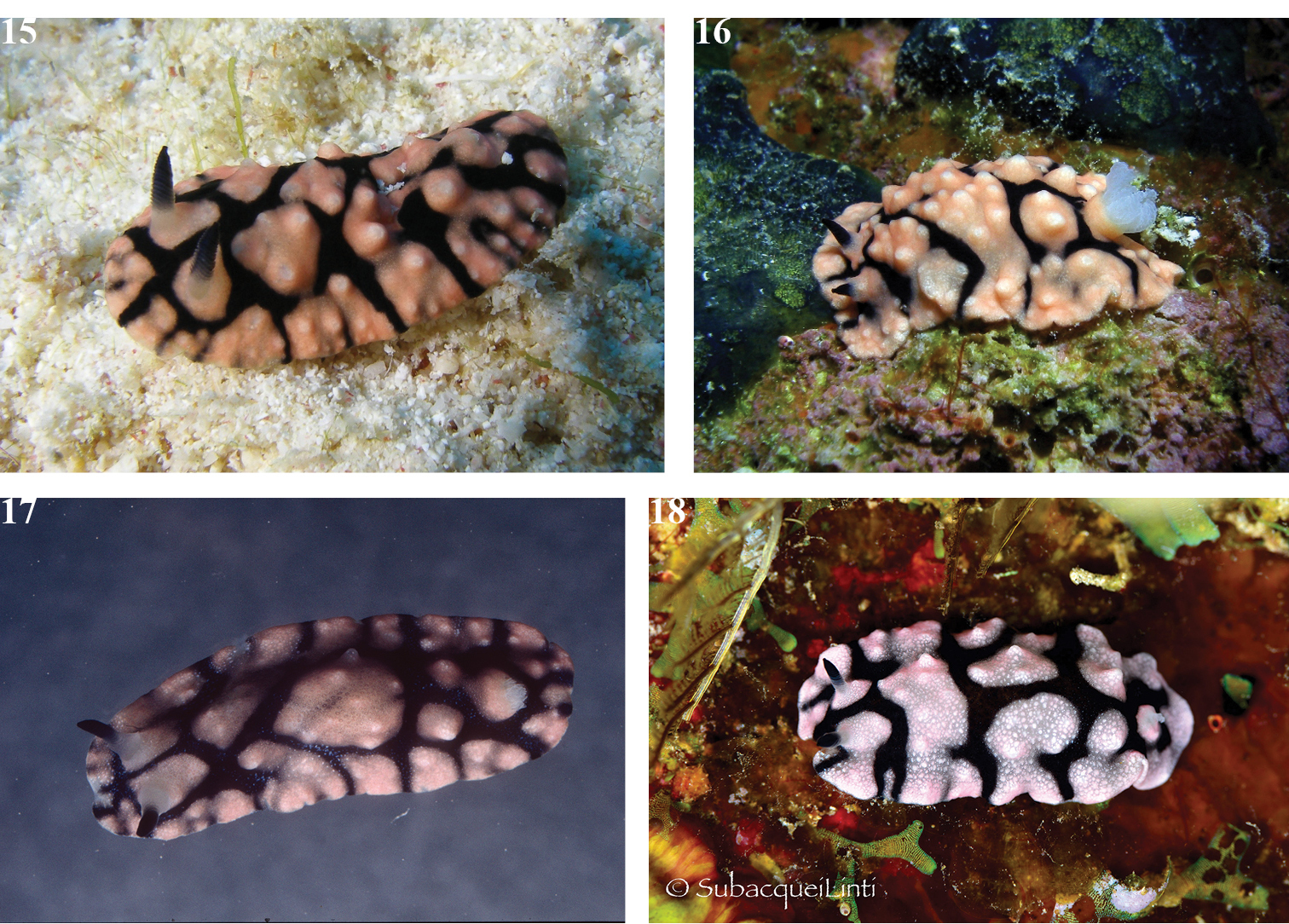
Plates 15-18.
Paradoris hypocrita
sp. nov., specimen and individuals illustrating constant patterns
15
Hurghada, 09 Sept 2010 (S. Kahlbrock)
16
Hurghada, 14 July 2010 (S. Kahlbrock)
17
paratype SMF 360587, Sha'arm el Sheikh, May 1980 (B.E. Picton)
18
Marsa Alam, 28 July 2014, photograph of 30 mm individual (Hsini Lin - LIN_0805).
The five preserved specimens (in alcohol or in formaldehyde) are all pale pink with approximately paired, rounded, polygonal, black markings (Fig.
9C
). The black rhinophores are retracted but just visible in most of the material. The white gills were only extended in two preserved specimens, the holotype SMF 360586 and SMF 360587, and the large gill cavity with its thin rim is clearly visible (Fig.
9B
).
All preserved specimens are curled ventrally to a greater or lesser extent except the holotype SMF 360586. The black lines remain on the dorsum and are visible through the hyponotum in the holotype SMF 360586 (Fig.
9D
). The foot is narrower than the dorsum, more than 1/2 to 2/3 the width of the dorsum in the less curled specimens (SMF 360586, SMF 360589). The penis is extruded in specimen A of SMF 360589 (Fig.
9E
). The foot is rounded anteriorly and tapered posteriorly. The anterior margin is bilabiate and both edges appear to be clearly notched in specimen B of SMF 360589 (Fig.
9F
) but this is an artefact of preservation. The oral tentacles are indistinct in all preserved specimens, certainly not as obvious as those of
P. liturata
or, in fact, most dorids. None of the photographs are helpful in showing them, although the bilabiate margins are just visible in Fig.
9E
.
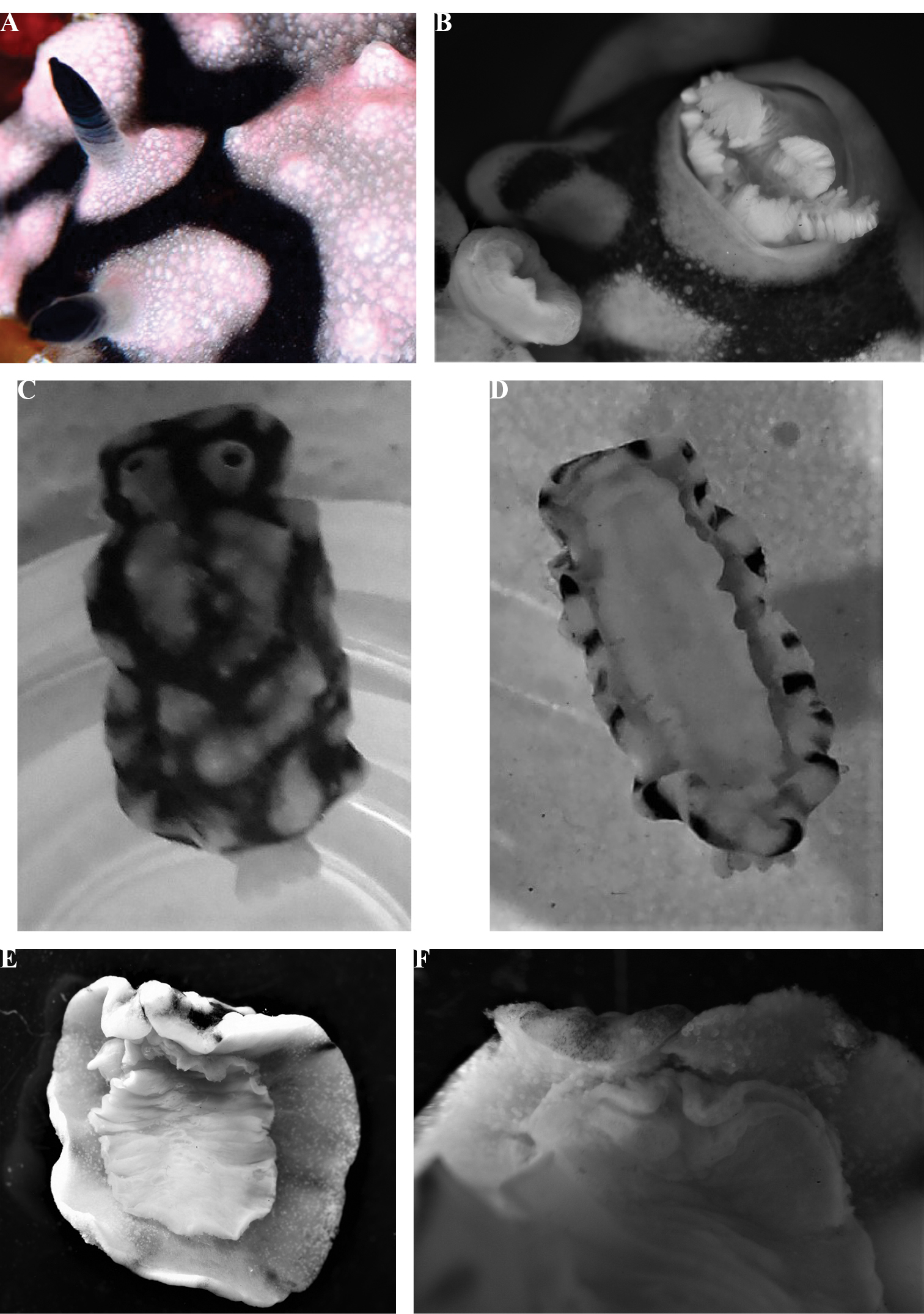
Figure 9.
Paradoris hypocrita
sp. nov.
A
detail of the granulation of the pink areas and the tubercles (photograph only, Hsini Lin LIN-0805)
B
gills partially extended, preserved paratype SMF 360587
C
dorsal view showing extended gills, preserved holotype SMF 360586
D
ventral view of preserved holotype SMF 360586
E
ventral view of specimen A SMF 360589 with penis extruded
F
anterior bilabiate foot margin of specimen B SMF 360589.
The jaws are formed of three plates (Fig.
10A
). The rodlets are slightly curved, each with a tapered rounded tip; the more worn rodlets have a rounder tip, and some are broken off (Fig.
10B
). The radula is asymmetrical and there are more teeth per row on the left side than the right side. The general shape of the radula is distinctive for the two
Phyllidiella
mimics,
P. liturata
and
P. hypocrita
: long and narrow, rounded at the old end, and with two long tails of sharp teeth at the new end (Fig.
11
). The radular formula of
Paradoris hypocrita
sp. nov. (n = 2) is 53-55
x
14-16 (left).0.8-11 (right).There is no rachidian, but a narrow space is present down the middle of the radula in its place (Fig.
12B, C
). The hooks of the lateral teeth are grooved, which is very difficult to see (Fig.
12A
, arrowed).
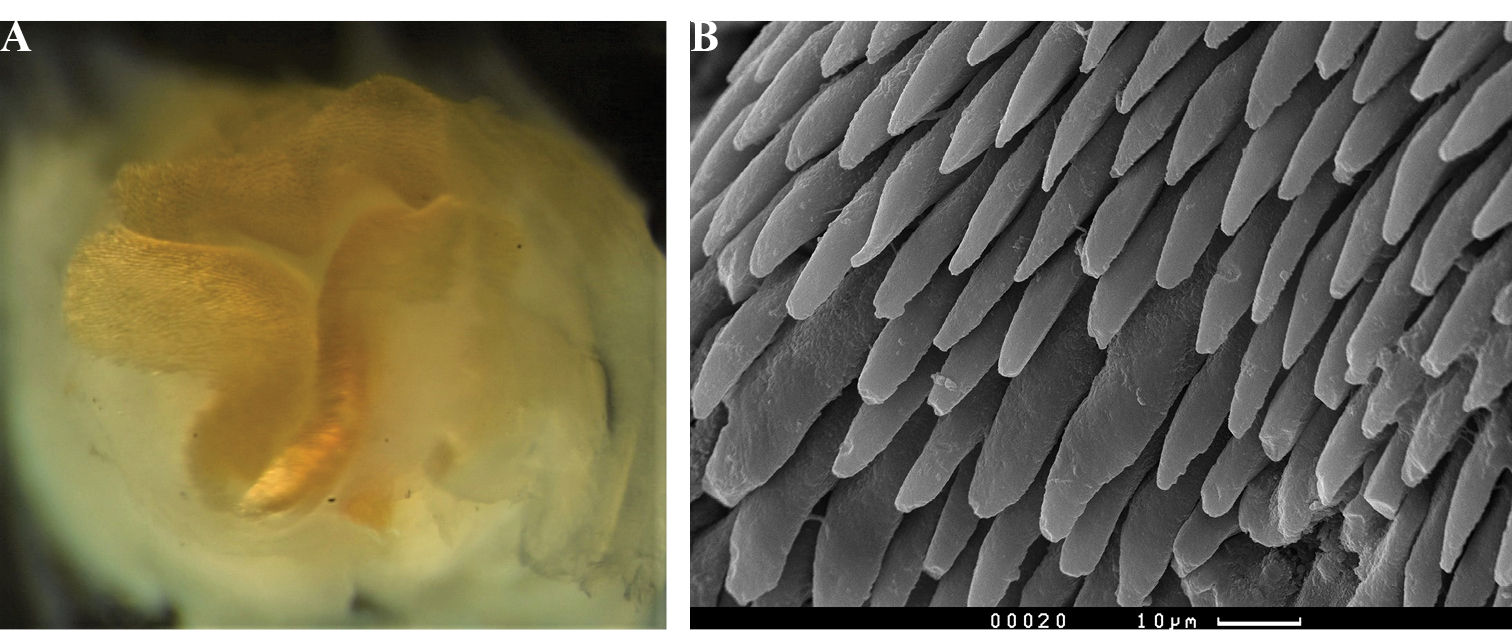
Figure 10.
Paradoris hypocrita
sp. nov., jaws of paratype SMF 360588
A
light micrograph of three plates
B
SEM of rodlets.
Remarks.
This species appears to be relatively common in the northernmost part of the Red Sea, based on the available photographs (
Rudman 2007a
, except the photograph from Borneo). It differs consistently in external morphology from
Paradoris liturata
, which is currently recorded only from Indonesia and PNG (
Dayrat 2006
), Malaysia (
Masayoshi 2002
), and the Philippines (
Okiedivenut 2007
). Note that the Red Sea species is easily distinguished from the west Pacific species on
iNaturalist (2007-2020)
and that there are no records in the Indian Ocean. Discodorid species are known to vary in notum colour and pattern and rhinophore lamellae counts, but the following differences between
P. hypocrita
and
P. liturata
can be observed.
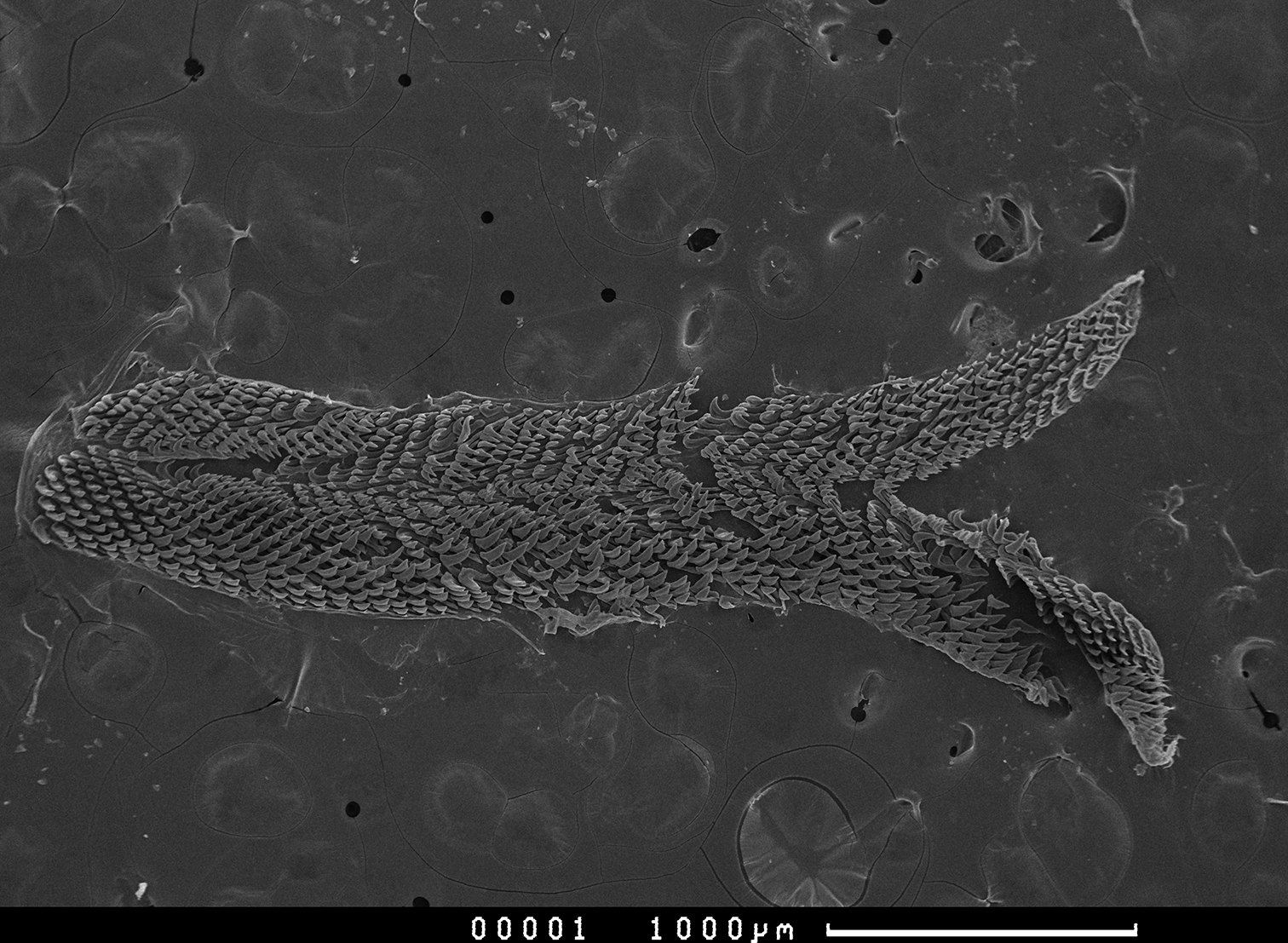
Figure 11.
Paradoris hypocrita
sp. nov., SEM of whole radula of paratype SMF 360588.
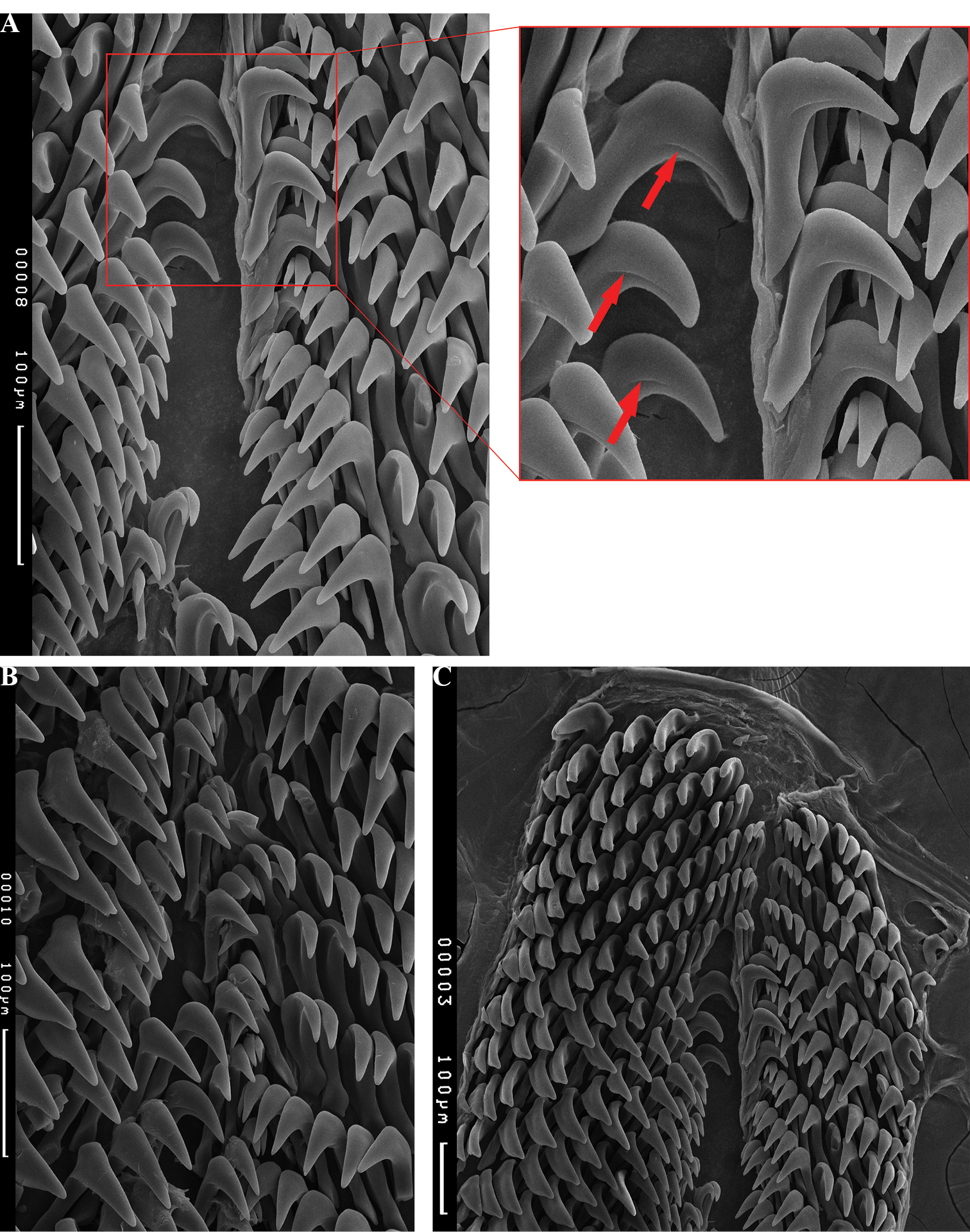
Figure 12.
Paradoris hypocrita
sp. nov., SEM radular images
A
middle rows [from Fig.
12C
] magnified to show a few of the teeth with the distinctive groove (arrowed); paratype SMF 360588
B
newer rows of paratype SMF 360589 specimen B)
C
old end of radula, paratype SMF 360588.
Externally, the black pattern of
P. hypocrita
sp. nov. forms a series of paired, loose polygons on the dorsum, sometimes incomplete, but in
P. liturata
the two or three black lines are longitudinal, either complete or broken (but note the black ground colour in a photograph (no specimen available) in
Dayrat (2006
: fig. 17) H from Papua New Guinea). The dorsum is (always) pink in
P. hypocrita
(described as grey in
P. liturata
(
Dayrat 2006
) but note the pink tinge in
Dayrat (2006
: fig. 17) and on Sea Slug Forum). There are 17 lamellae counted from photographs (specimens are contracted) in
P. hypocrita
, while
Paradoris liturata
has 13, 15, or 16 lamellae on the rhinophores. However, one head shot of
P. hypocrita
bears 13 or 14 lamellae on one side and 16 or 17 on the other, indicating similar variations in both species. There are 6-8 gills in
P. liturata
but only six in
P. hypocrita
, coloured various shades of grey in the first species and white in the latter.
The three jaw plates and form of the radulae and teeth are very similar if not identical in both species, albeit based on few specimens, but the numbers vary with fewer teeth per row in
P. hypocrita
sp. nov. The radular formula of
P. liturata
is 45-79
x
18-21 (left). 0.12-14 (right) (n = 4) while in
P. hypocrita
the formula is 53-55
x
14-16 (left). 0.8-11 (right) (n = 2). Tooth shape in discodorids is similar and at this level of magnification no particular differences are visible. It may be that
Dayrat (2006)
is correct and this species forms part of a very variable
P. liturata
species. However, the high endemism of nudibranchs in the Red Sea currently being revealed (see Discussion) combined with the consistent polygonal dorsal pattern and fewer teeth per row in the radula of the Red Sea specimens examined are considered sufficient to warrant separation. It is also noteworthy that there are no published records of
P. liturata
from the Indian Ocean: the westernmost Pacific record is from Indonesia (
Dayrat 2006
), further supporting the distinctiveness of the Red sea species.
Paradoris liturata
has not been recorded in the Indian Ocean but there are at least two species of
Paradoris
resembling phyllidiids which remain unidentified in the western Indian Ocean. One is pink with three to many longitudinal, usually broken, lines, granular tubercles of different sizes, and grey gills (
Bidgrain 2020a
;
Anderson 1988-2020
); this may prove to be
P. liturata
and if so, would the first records of this western Pacific species in the Indian Ocean. The second species is white with five longitudinal wavy black lines and evenly sized tubercles and is probably a new species (Bidgrain 2020b). The Red Sea species clearly differs from both of these in the pattern of the black lines; additionally there are no records of either undescribed species in the Red Sea.
Etymology.
This epithet is based on the Latin noun
Paradoris hypocrita
(mime, mimic) and refers to its superficial resemblance to another family, the
Phyllidiidae
.